
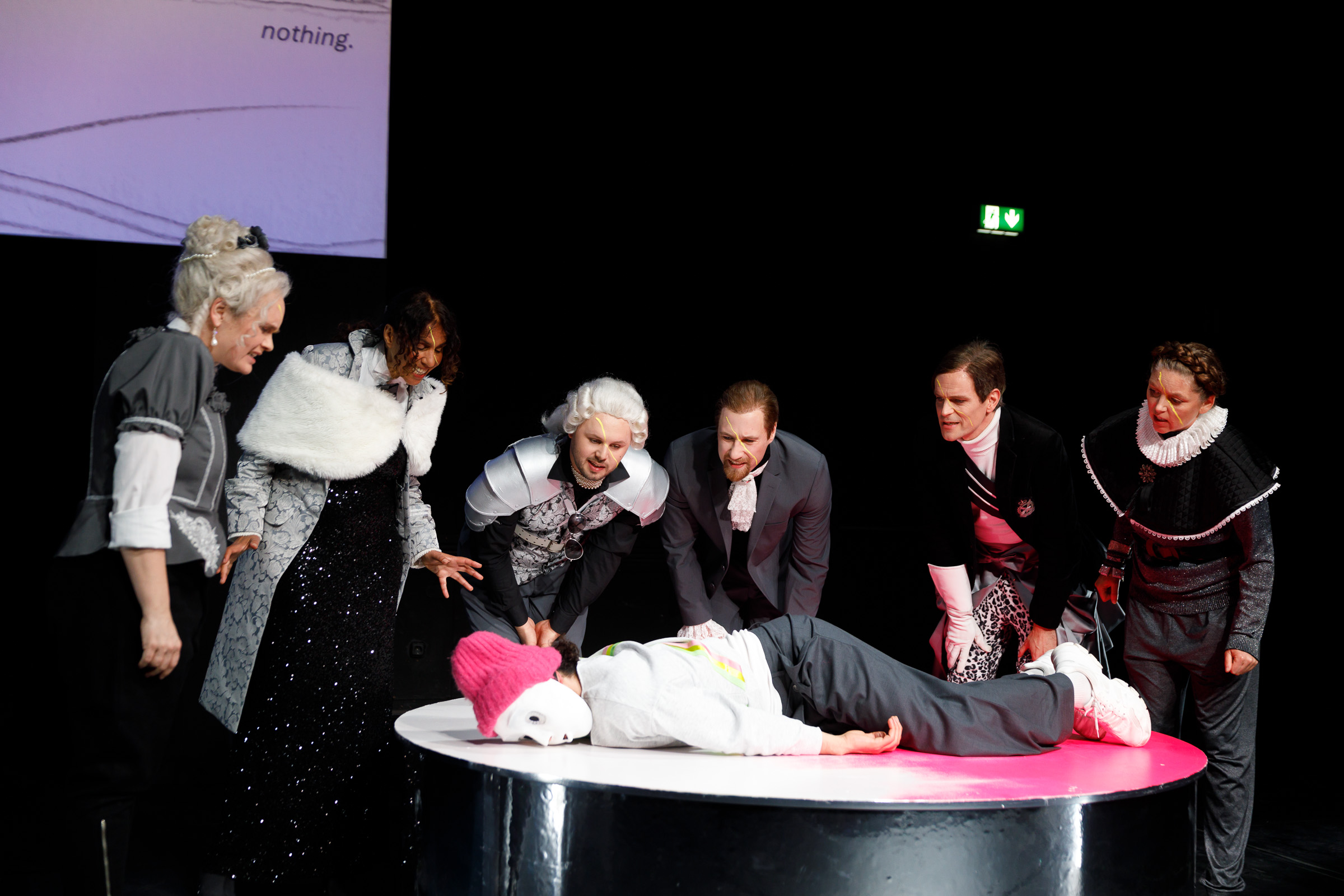
A contemporary drama by Arad Dabiri
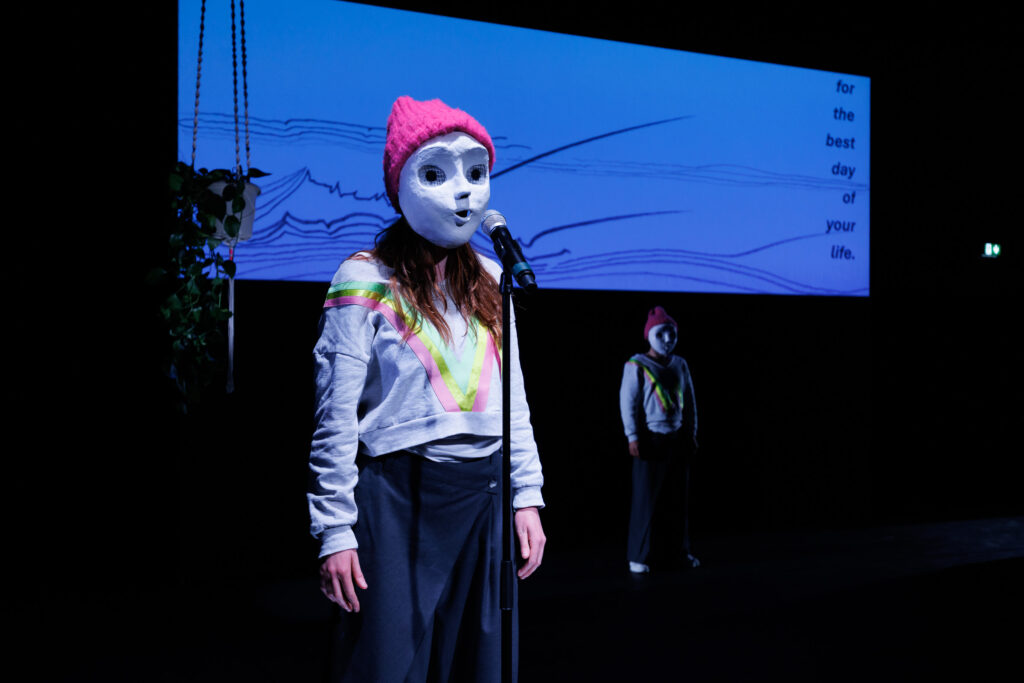
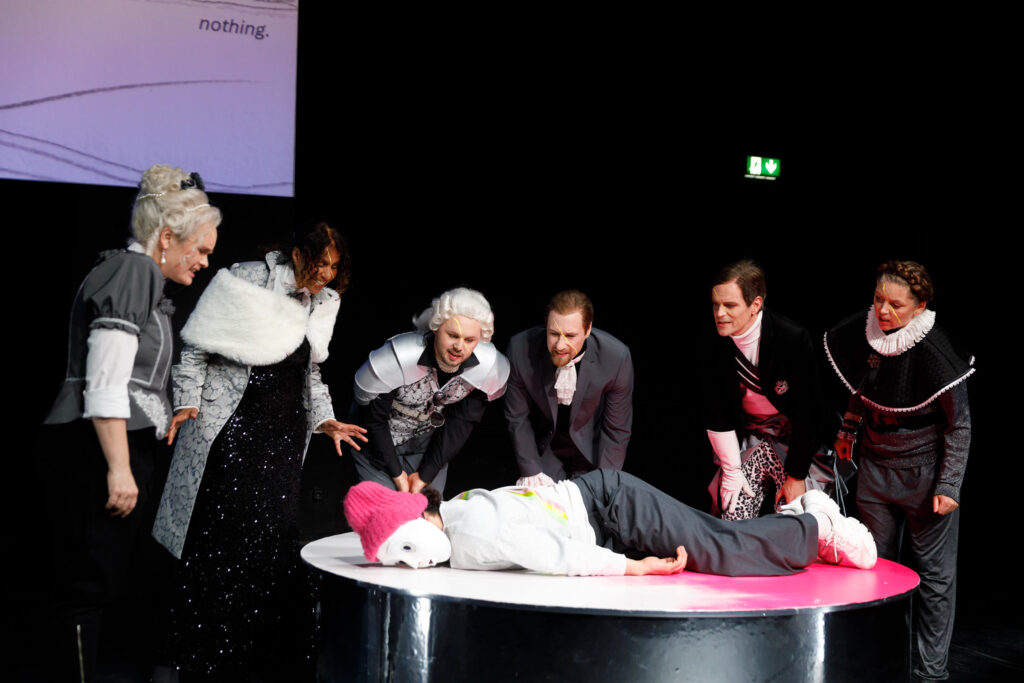
A child lies in the centre, asleep, still. All around, a chorus prepares itself for the impending ritual: the child must be sacrificed, rationality must triumph over compassion, the community must be saved through this sacrifice. Then the child wakes up. It speaks, asks questions, accuses: What value does a society have that believes it needs the brutal exclusion of others for its survival? Where does the urge come from to organise our society like an allotment association garden?
Starting from an archaic basic situation, Arad Dabiri offers a glimpse into the current state of humanist principles in the world.
Rich in associations, the text weaves its way through myths such as the Garden of Eden to demonstrate that humanity will only succeed in creating an earthly paradise if it envisions this peaceful place as belonging to everyone, without boundaries. LEBENLIFEHAYAT!
LEBENLIFEHAYAT! is a long poem; it is a long-overdue cry of anguish in a world that is already ablaze, yet where a spark of hope has also been kindled, and where the search for future narratives has begun: this is a new beginning, a fresh start, a re-start.
The play was selected as part of the “Future Narratives for Planet Earth” open call at the Hessisches Landestheater Marburg. “Future Narratives for Planet Earth” is a multi-year EU project involving various partner organisations across Europe. The world premiere will take place at the Hessisches Landestheater Marburg, and the play will also go on tour in 2026 to Leuven, Belgium, and Graz, Austria.
LEBENLIFEHAYAT! will be performed with English subtitles.
For anyone aged 15 or over who is curious about stories of the future and visions for the world.
PRESS REVIEWS
‘This lyrically elegant, rhythmic call for the creation of a new world presents the Earth as a boundless paradise for all.’
‘In the intense production by co-artistic director Carola Unser-Leichtweiß, Dabiri’s play celebrated its premiere on Saturday to a full house at the Kleiner Tasch, receiving a long round of applause.’
‘With two performers for ‘Aria’, director Unser-Leichtweiß highlights two key aspects of this character: Saleh stages the physicality with impressive vitality and artistry, whilst Plenker delivers an outstanding performance both vocally and in his delivery.’
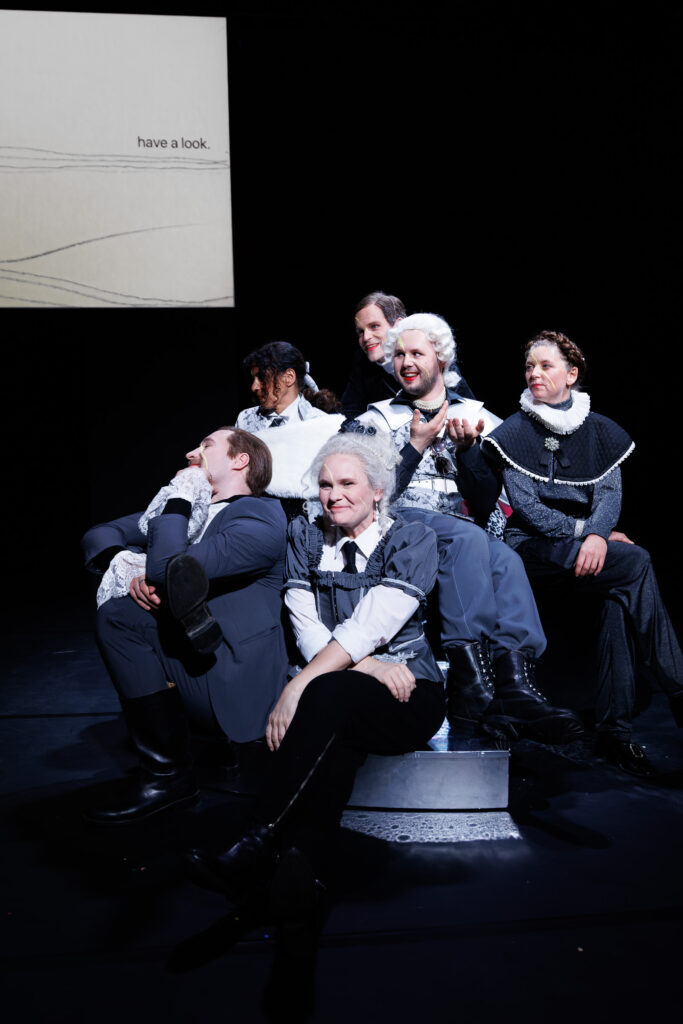
‘As the ‘Children of the World’, Flamur Blakaj, Saskia Boden-Dilling, Lisa Grosche, Bibiana Malay, Georg Santner and Christian Simon drive the tragic events forward. The precision of their delivery is particularly noteworthy. The magnificently harmonious ensemble transitions flawlessly from the chorus to the solo parts and back again.’
(Sabine Jackl, Oberhessische Presse)
“LEBENLIFEHAYAT!” is a treatment about the power and fatigue of a crowd. On a moment when all who belong to it shed their differences and feel as one. On exclusivity and (national) identity. In her introduction, director Carola Unser-Leichtweiß speaks of a declaration of love for the complexity of the world.”
(Marie-Luise Wenzel, Die Junge Bühne)
„The play, which is less a drama then a long poem and quite comparable to Rilkes `Duineser Elegien´ or W.H. Auden ´Age of fear´, was produced and shown in context of the EU – Project „Future Narratives for Planet Earth´.“
‘For the longest time however, it is the script – and the actors – that carry this successful world premiere. Whilst it depicts a world that has almost been destroyed by money, envy, excessive consumption and environmental degradation, it repeatedly counters this with a decidedly biting sense of humour and refuses to let up, speaking of the opportunities that every new life brings.’
(Matthias Bischoff, Frankfurter Allgemeine)
„Everything flows, associatively and full of allusions. In print, the text seems to breathe. The words are centred on the page, sometimes just one per line, sometimes spreading out widely; visually, the lines form a surging and ebbing stream. It is astonishing, how director Unser-Leichtweiß worked this long poem for the Studiobühne at the Theater am Schwanhof, and how she won a theatrical text from it without sacrificing the poetry, rhythm and elegance.”
„Greta Lou Plenkers is irate in accusing, upright in her not understanding, reconcilingly building bridges, optimistic in her faith, that mankind still can make it: „The zero point is always within us.“ Then again Faris Saleh, who speaks parts of the text in arabic language, carries the pain and the suffering in his gaze, traces of a life denied.“
(Joachim F. Tornau, Theater der Zeit)